
Homeowners' pick for heating and cooling across north Florida and the Suwannee Valley
A Frozen AC Coil and What Causes the Ice
You open the closet or look at the indoor unit and there is a block of ice on the coil, or water dripping where it never dripped before, and the air from the vents has gone weak and lukewarm. That is a frozen evaporator coil. Turn the cooling off, leave the fan running, and call us for air conditioning repair anywhere we cover in Florida, Georgia and South Carolina.
Call (888) 381-2953- Real people on the phone
- 7 days a week
- Quote in writing before any work
Taking calls until 5:00 PM ET
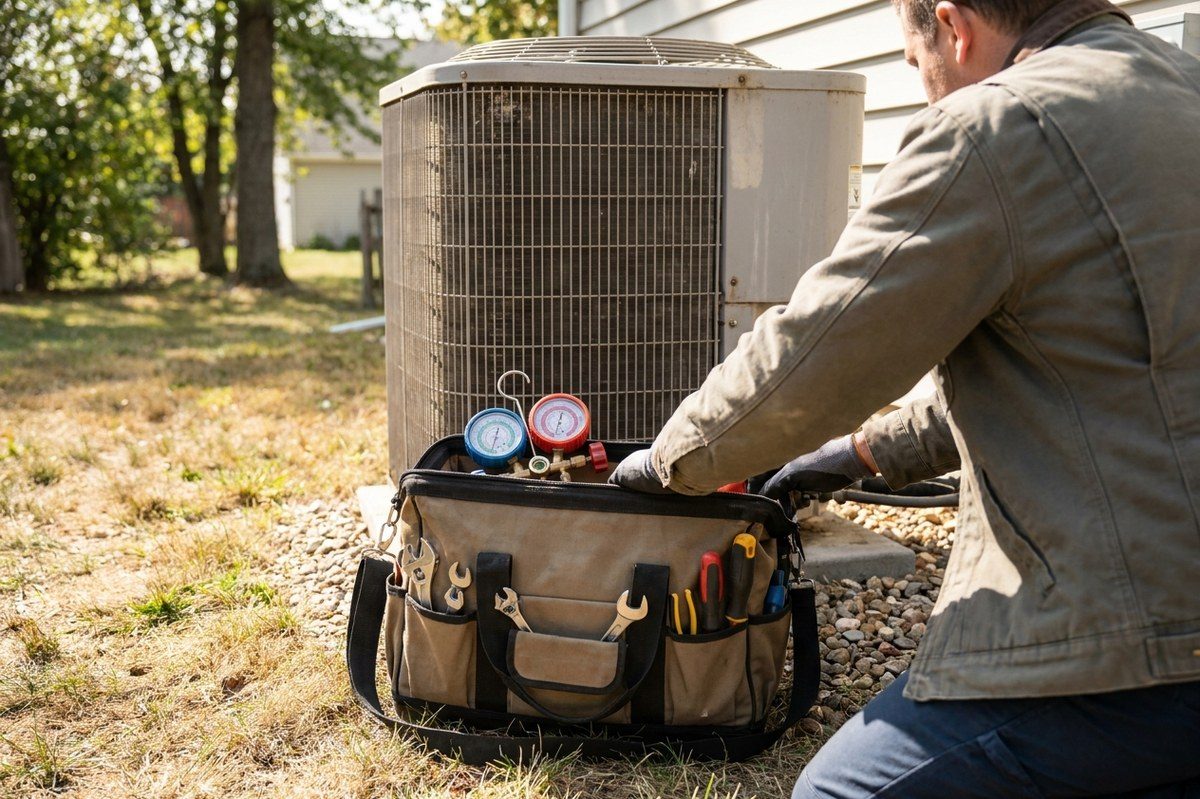
By the Suwannee Valley AC & Heating service team · reviewed by our working technicians
What ice on the coil is actually telling you
A frozen coil means the refrigerant inside it is running colder than it should, or not enough warm house air is moving across it. Either way, moisture that normally drains away freezes instead, and the ice builds until it blocks airflow completely. Once that happens the house stops cooling, and the melting ice can overflow the drain pan onto drywall, insulation or a hallway floor. Ice is a symptom, never the root problem. Running the system harder makes it worse, because the compressor keeps pulling liquid refrigerant it cannot boil off. Shut the cooling off at the thermostat, switch the fan to ON, and let it thaw while you wait on us.{}]}
Cause one: airflow, the cheapest and most common
Most frozen coils we find come down to air not moving. A filter left in too long, especially in a sandy yard where dust rides in on every breeze, chokes the return until the coil goes below freezing. Closed or blocked supply vents do the same thing, and so does a return grille half hidden behind furniture. Older homes on our rural routes often have crushed or disconnected flex duct in the attic, which starves the coil no matter how clean the filter is. A dirty blower wheel is another airflow killer we see on systems that have gone a few seasons without service. This family is the least expensive to fix and the first thing we rule out.{}]}
Cause two and three: refrigerant charge and controls
If airflow checks out, we look at refrigerant. A system low on charge runs low pressure, and low pressure means a colder coil that ices over. Low charge almost always means a leak somewhere in the coil, line set or outdoor unit, so simply adding refrigerant is a patch and not a repair. Heat pumps sitting in sandy soil in our area can suffer line set damage or corrosion at fittings over time. Beyond charge, a stuck metering device, a failed blower motor, a bad thermostat call or a control board that keeps the compressor running while the fan is off will all freeze a coil. These require gauges and metering, not guesswork.{}]}
What you can safely check yourself
Keep it simple and keep your hands off refrigerant lines and electrical panels. Check that the thermostat is set to COOL with a reasonable temperature and that the batteries are good. Look at the breaker for the indoor and outdoor units and see if one has tripped. Pull the filter and hold it up to a light. If you cannot see light through it, change it. Walk outside and clear grass clippings, leaves and pine straw at least a couple of feet back from the outdoor unit. Walk the house and confirm supply vents are open and returns are not blocked. Then set the fan to ON, cooling OFF, and let the ice melt.{}]}
What we do differently on a service call
We start with the thaw, because nothing can be measured through a block of ice. Once the coil is clear we take static pressure and temperature readings across it to see whether air is actually moving the way the system was designed to move it. We check the blower wheel, the coil face and the drain. Then we put gauges on and compare suction and liquid pressures against outdoor and indoor conditions to judge the charge honestly. If it reads low, we search for the leak instead of just topping it off. We check the metering device, the contactor and the control sequence, and we tell you plainly what failed and what the fix involves.{}]}
When it is time to book
A Frozen AC Coil and What Causes the Ice — common questions
How long does it take for a frozen AC coil to thaw?
With the cooling off and the fan set to ON, most coils clear in two to six hours. A heavy block of ice can take longer. Keep towels near the indoor unit, because melting ice can overwhelm the drain pan.{}]}
Can I run my AC while the coil is iced up?
No. Running it keeps the coil freezing, blocks airflow completely and risks damaging the compressor, which is the most expensive part in the system. Switch cooling off, run the fan, and schedule air conditioner repair.{}]}
Does a frozen coil always mean low refrigerant?
Not always. Restricted airflow from a loaded filter, closed vents, a dirty blower or damaged duct causes just as many frozen coils. We measure airflow first, then check charge, so you are not paying for refrigerant you did not need.{}]}
How it works
- Step 1
Tell us the symptoms
You describe what changed. No cold air, a breaker that keeps tripping, water near the air handler, a smell, a noise. That gives us a head start on parts before we ever leave the shop.
- Step 2
We diagnose on site
A technician checks the thermostat, the electrical side, airflow through the filter and coil, refrigerant behavior and the outdoor unit. We look at the whole system, because a frozen coil usually points somewhere else.
- Step 3
You decide the repair
We explain what failed, what it takes to fix it, and how long the rest of the system is likely to hold up. You pick the repair. We do not start work you did not approve.
- A real person answers
- Open 7 days
- Written quote before work starts
Why homeowners call us
- Rural routes are normal for usWe drive long stretches between calls and we plan for it. Trucks carry the common heat pump and air conditioner repair parts so a diagnosis does not turn into a second trip on a hot afternoon.
- Heat pumps and sandy soilMost homes we visit run a heat pump, and sand, lawn clippings and pollen pack the outdoor coil fast. We clear it, check the defrost side in winter, and show you what we found before we close it up.
- Well water housesHomes on well water bring their own quirks, from pump-driven electrical noise to hard water on drain lines and condensate pans. We know where those systems clog and where the slow leaks hide.
- Heating repair tooCold snaps in this region are short and hard. We do heating repair and heater repair on heat pumps, strip heat and furnaces, so one crew handles your system in July and again in January.
- All major brands, gas & electricOne independent crew for Carrier, Trane, Lennox, Goodman, Rheem and more.
- Straight answersIf a system is not worth repairing, we say so, often right on the phone.
About this guide
Checked everything on the list and it still acts up?
Describe what you found and we'll take it from there. Booking takes about a minute.
- A real person answers
- Open 7 days
- Written quotes
- All major brands
- Gas & electric
Rather not call? Get a free quote →